Safety
Why does the circuit breaker keep tripping? Common causes and when to call an electrician
A single trip is not necessarily a fault, repeated tripping is. What the breaker is telling you, the common causes and when not to wait.
Published by: Andrii MatovkaPublished 7 min read
In this article
A circuit breaker is not your enemy. It trips to protect the wiring from overheating. When it drops out, something is happening on the circuit it protects. There are several causes: some are harmless, others need an electrician quickly.
Breaker or RCD: what actually tripped
A distribution board usually holds two kinds of protection. The circuit breaker protects the wiring against overload and short circuit. The RCD (residual-current device) reacts to current leaking outside the circuit (for example through a faulty appliance or damp) and protects against electric shock. You look for a different cause depending on whether the breaker or the RCD tripped, so remember which one it was.
The most common causes
| Cause | How it usually shows | What to do |
|---|---|---|
| An overloaded circuit | The breaker trips when you switch on several appliances at once (for example the kettle and the toaster). | Unplug some appliances. If it repeats, have the division of circuits assessed. |
| A faulty appliance | It trips when one particular device is switched on. | Unplug the device and stop using it; have it repaired. |
| A short circuit or damaged wiring | It trips immediately after switching on, sometimes with a bang or a spark. | Do not switch it on repeatedly and call an electrician. |
| Leakage current, damp (RCD) | The RCD trips, often in rain or damp, on outdoor or bathroom circuits. | Unplug the appliances from the circuit and have the cause found. |
| A loose contact, overheating | A socket or breaker is warm, there is a smell, the lights flicker. | Stop using the circuit and call an electrician. |
| A worn breaker or an older board | It trips for no obvious reason, even under a small load. | Have the board assessed, see Distribution boards. |
| Inrush current | With some appliances that have a motor or a power supply, a brief inrush current can trip the breaker. | If it repeats, have the circuit assessed. |
What you can safely do yourself
- Find out which breaker tripped and which appliances were on its circuit.
- Unplug the appliances from the sockets on that circuit. Then you may switch the breaker on once by its lever. If it trips again, do not switch it on repeatedly.
- If there are no warning signs, plug the appliances in one at a time. As soon as the breaker trips, stop using the appliance you have just plugged in; the culprit is the device plugged in last.
- Note the circumstances: when it trips (rain, the oven, the washing machine) and photograph the board from the outside. It helps during a consultation.
Warning signs: when not to wait
- a smell of burning, darkened or deformed plastic,
- sparks, crackling or buzzing in the board or a socket,
- a hot breaker, socket or switch,
- a breaker that trips immediately after it is switched on,
- an RCD that trips repeatedly,
- a tingle or shock when touching an appliance or a metal part.
In that case do not use the circuit and call an electrician. If there is smoke or fire, call 112. For an acute fault an emergency call-out is available 24/5. Other signs of an ageing installation are in When does electrical wiring need replacing?.
What the marking on a breaker tells you
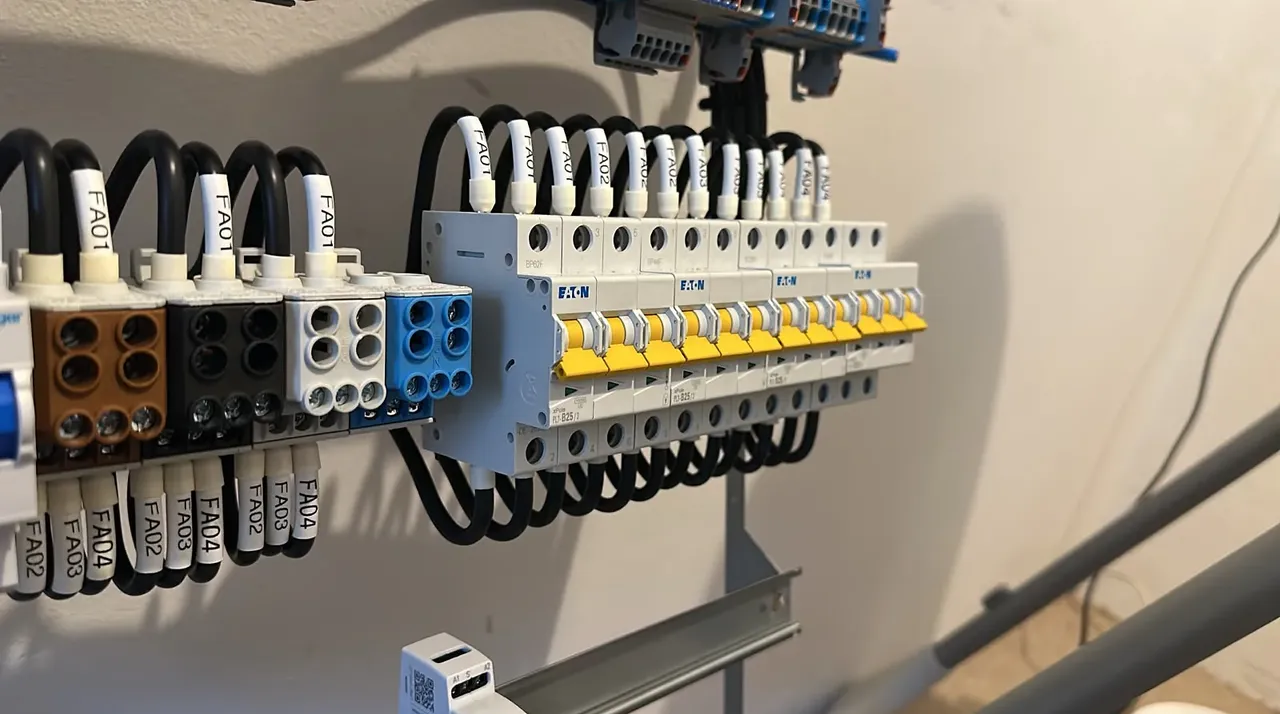
A breaker usually carries a letter and a number, for example B16. The letter gives the tripping characteristic and the number the rated current in amperes. The values are matched to the wiring and the appliances on the circuit, which is why a breaker is never replaced with a stronger one. If the circuits in the board are clearly labelled, it is easier to see what each breaker protects; labelling circuits is part of the Distribution Boards service.
How to prevent tripping
- Spread out high-power appliances. Do not switch on the kettle, toaster, hairdryer or hotplate all at once on one circuit.
- Do not use extension leads and adaptors for high-power appliances. Add a socket where you need it instead; see How many sockets do you need in a flat and where should they go?
- Keep an eye on the condition of appliances and cables. A damaged cable, an overheated plug or an appliance that regularly trips the breaker needs repair.
- With new appliances (oven, air conditioning, car charging) check that the circuit and the board have enough capacity; the electrician assesses that. Planning circuits and reserves is covered in Electrical installation in a new build: what to prepare before work starts?.
What the electrician does
The electrician looks at the board and the circuits, asks about the circumstances of the tripping and takes measurements where needed. The result is finding the cause and a proposed solution, from repairing or replacing a faulty part to adjusting the circuits or the board. I deal with such faults as part of the Repairs and Faults service. Clear labelling of circuits makes the cause easier to find; what it looks like is shown by the project Electrical distribution board – Czech Republic. I do not perform electrical inspections (revize); if you need an inspection report, it is ordered from an inspection technician.
If the cause turns out to be a faulty or overheated socket, what the price of replacing it is made of is explained in How much does it cost to replace a socket?.
Frequently asked questions
Is it normal for a breaker to trip once in a while?
A single trip, for instance when you switch on several appliances at once, can be an overload. If it repeats or the breaker trips even under a small load, there is a reason to find the cause.
Why does it trip when I switch on the oven or the washing machine?
It may be a faulty appliance, an overloaded circuit or a loose contact. For a large appliance it is worth checking that it has a circuit of its own. Do not ignore repeated tripping.
Can I fit a stronger breaker so it stops tripping?
No. A breaker is matched to the wiring it protects; a stronger one does not solve the problem and can overheat the wiring. The cause has to be removed.
The breaker or RCD trips only in rain. What could it be?
It may be damp on the circuit, especially an outdoor one, in a socket or a light fitting. Do not use the circuit and have it checked.
What is the difference between a breaker and an RCD?
The breaker protects the wiring against overload and short circuit, the RCD reacts to leaking current and protects a person against shock. Both are usually in the board.